Test Your ‘True’ Balance, Part 1

From time to time in class we focus on standing balance – it’s a good way to test all the principles we practice throughout the classes & as an indication of general muscle balance health. So I wanted to use this post to look at what goes on when we try to balance, how to test it & how to improve your ‘true’ balance.
So our body’s stabilise by using the relationship between the proprioceptive system (that’s information coming from the muscles, joints & tendons) & the processing of that sensory input (i.e. what the brain tells the body to do with that information). Tight or shortened muscles send ‘fixed’ information from your proprioceptors and this data/sensory input gives incorrect information to the decision centre (the brain) which in turn acts on this mis-information. The outcome is an overcorrection, a wobble or lurching movement in an attempt to stabilise you. Any restrictions or sub optimal muscle length tension will alter the correct information given to the brain.

Testing your ‘true’ balance – See how well you’re balancing with these simple tests.
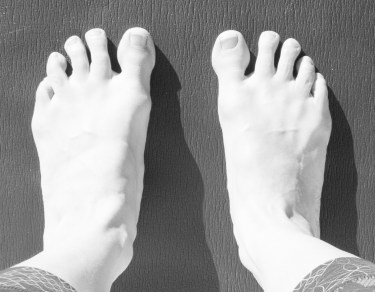
pilates_16dStand with your feet pelvis width apart & check your feet are straight (as in the outside edges, see pic) – how does this feel? Any wobbles? Now close your eyes & see if there’s any difference with them open or closed. Maybe you felt you moved about more with your eyes closed – this is the ‘true’ part of the balance test – your eyes are not part of the sensory input we speak about when we mean whole-body balance, they are not part of the proprioceptive system they are part of the vestibular system (eyes & inner ears) but the poorer your proprioceptive system is the more you rely on your eyes to make corrections. So in order to stop the eyes doing all the work (& incurring eye muscle fatigue, dizziness & age-related changes in vision) you need to fix your body’s internal sensory input or proprioceptive system.

The progression to the 2 foot balance with eyes shut is to come onto a single leg with eyes shut. Whilst we may have some muscle tension issues within the body it’s also our inability to process information through our feet & inform our bodies of correct posture, due to footwear that down trains our proprioceptive system. Think any type of heel, thick inflexible soles & too narrow toe boxes.

So hopefully this will give you a clearer idea of what you are aiming for when you consider/assess your balance – test yours & practice some ‘eyes shut’ standing to monitor your progress.
3 Restorative Shoulder Stretches

If you have tight shoulders & are looking for relaxing ways to ‘unstick’ them here’s a few ideas that we use in the classes that also work really well particularly as transitions from one exercise to another. If you imagine where your arms are hanging most of the day & the range with which you mostly use them in you can see that these 3 variations on a shell stretch really take them into much more of an unused plane thereby freeing up all the stuck tissue around pectoralis & latissimus dorsi.

shell_4

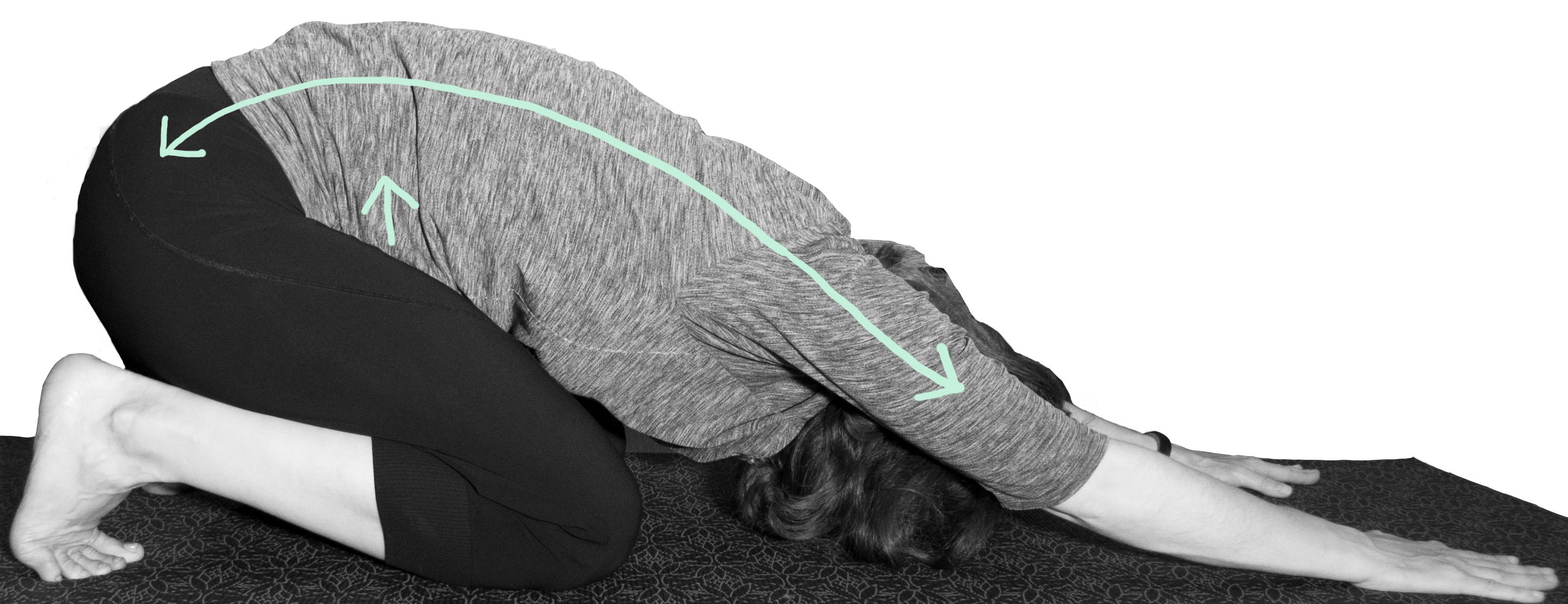
The picture above shows how you should anchor the stretch. Arms are pushing away into the mat & sit bones are pulling down, so you’re flexing the lumbar/lower spine by engaging the abdominals & pulling the ribs up (in the direction of the second smaller arrow). By drawing the ribcage up you will tension the stretch better through the shoulders instead of over extending into the thoracic spine – have a go with the ribs up & then down on your thighs & you’ll feel the difference.

shell_series

If you want to optimise the stretches try to work with the breath by directing it into the ribs & underlying diagram in a 3 dimensional way (think like an accordian). You’ll be able to feel the skin stretch around the rib cage & so try to emphasise that expansion as you inhale & breathe out the tension from the stretch as you exhale.

  • In the first variation the arms are straight out in front, trying to keep the hands in line with the wrists, elbows & shoulder. Head is relaxed, toes are tucked under for an extra, bonus plantar fascia stretch! There are many variations on the specifics of this pose for example Yoga’s Child Pose comes with a different emphasis but here as we are trying to specifically release the fascia around the shoulders I’ve selected these teaching points.
  • In the second picture the arms are externally rotated with the palms up & correspondingly the forearms are also rotating outward – you will feel how this tensions the stretch differently & you’ll probably find it more of a challenge. See how far round (or not!) you can get your thumbs/backs of the hands flat to the floor! Head relaxed & breathing wiiiiide! Keep thinking about the same anchor points, this is not a flop-on-your-thighs-&-go-to-sleep kind of stretch, you want to be actively working on the position both with the breath & with the anchor points. As the intensity of the stretch dissipates you can try to reach a little further.
  • Lastly we’re working more laterally into the sides of the back by bringing one arm all the way across & anchoring onto the the other side. This time we breathe into that side – feel the skin stretch & try to expand it with each inhalation.

For more information or to attend one of my sessions get in touch & fill out my contact form!

……And Breeeeeeathe!!

Different Pilates teachers put different amounts of focus on the breath  & whilst it can add to the seemingly endless checklist of things you are trying to get right in an exercise. For me, it is key to the success of any core restoration & here’s why.

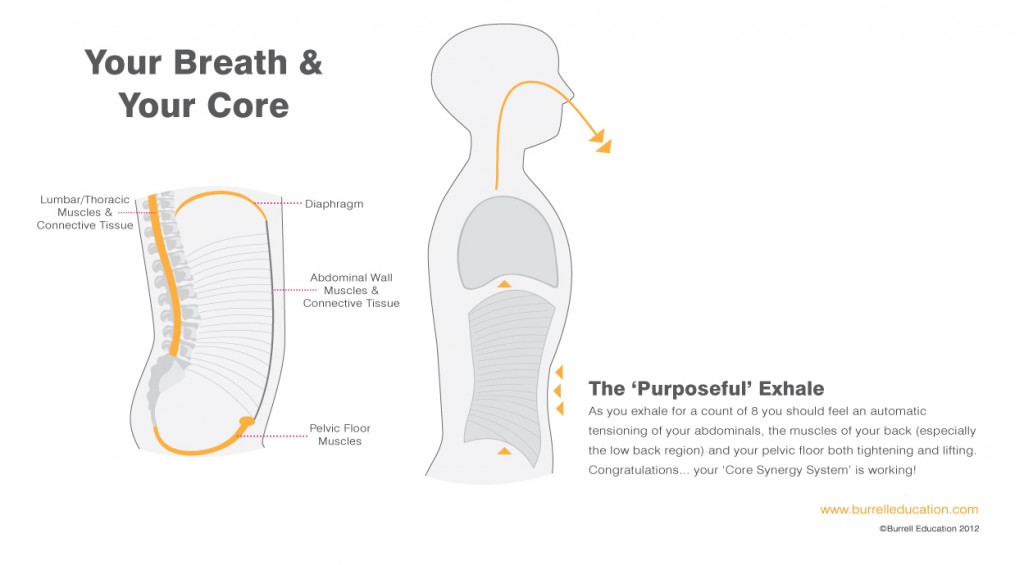
Once you understand the body’s breathing apparatus & functionality it becomes quite clear that we get an intrinsic core contraction (tensioning) with each exhale & an intrinsic expansion (or opening) with each inhale so only by harnessing this inherent bodily function will we truly get the core working optimally. Working against this pattern will help facilitate back pain, exacerbate a diastasis recti & generally leave you vulnerable to injury.

Your-Breath-Your-Core-1024x565

But as well as providing an intrinsic support system for the body, breathing correctly also helps reduce stress – controlled breathing can cause beneficial physiological changes that include:

  • lowered blood pressure & heart rate
  • reduced levels of stress hormones in the blood
  • reduced lactic acid build-up in muscle tissue
  • balanced levels of oxygen & carbon dioxide in the blood
  • improved immune system functioning
  • increased physical energy
  • increased feelings of calm & wellbeing.

Conversely when a person is under stress, their breathing pattern changes. Typically, an anxious person takes small, shallow breaths, using their shoulders rather than their diaphragm to move air in & out of their lungs. This style of breathing disrupts the balance of gases in the body. Shallow over-breathing, or hyperventilation, can prolong feelings of anxiety by making the physical symptoms of stress worse as well as facilitate adaptively shortened muscles along the neck & shoulders.

Try practising the breathing exercise described above whilst lying on your back in a quiet area – then begin to introduce some gentle core exercises as you do so & see how well incorporating the breath helps engage the whole core system.

How To Lift Properly

I’ve adapted this from a list included in Isa Herrera’s book ‘Ending Pain in Pregnancy’ (a must read if you’re expecting!) even if you’re not pregnant you can be sure that following advice given to a demographic with arguably the most compromised core system out there has to result in the gold standard in lifting advice!!

  • Bring the load/Object Close: Bring your body as close to the load/object you are about to lift as possible. This will prevent you reaching too far forward to grab the object, placing increased stress on the low back. You want the object almost directly underneath your body before you lift it.
  • Wide base of support: You want a wide base of support when you lift objects to improve your balance & allow you to reach the object without straining the back or legs. Widen your stance & try to keep your toes out, as if you are about to straddle the object.
  • Squat down & bend your knees: To reach the object, you will need to squat down by bending your knees. The most important aspect of squatting down is maintaining a flat back with a slight lumbar curve or arch. This is what helps the jelly in the vertebra stay centred, placing less stress on the intervertebral discs.
  • Keep the load close: When you grasp the object, bring the load as close into your body & stand up with your back remaining straight up & down.
  • Take steps, do not rotate: Do not rotate, or twist your trunk to place the object on a different surface. Instead, take small steps with your legs to reposition your body. Set the object down using the same principles.

Remember, proper body mechanics take time but by mastering these steps you’ll prevent aggravating existing problems & reduce risk of future injury.

5 Core Exercises To Practice

Regular conditioning of your core with proper muscle activation is key to maintaining good alignment & preventing back, neck & shoulder pain. This post will be a reminder for some of the exercises I teach in the classes as well as add a bit of variety for home practice.

post2First make sure you create space & time to focus on your technique – you will need to use your brain to find the right muscles (!) – predominately the co-contraction between transversus abdominis (TVA), pelvic floor & multifidus AS YOU EXHALE!

Try this technique to engage with your TVA:

Lie on your back with your spine in a neutral posture (slight curve in lower back). Take a breath in & as you exhale think about lifting your lower tummy up (not sucking in) & *gently* drawing your tummy button toward your spine – you should not feel any movement of your hips, pelvis or spine & you can feel the TVA activate by placing your fingers on the inside of your hip bones. It should feel like a deep tension not so much that it pushes your fingers away.

Try holding this contraction for 3-5 seconds & then release – breathe throughout this exercise! Repeat & hold for 3 sets of 10 repetitions 3-4 x a day.

Once you’ve mastered this you can apply it to all movements/exercises that involve any level of effort. Just remember to go with the breath pattern always exhaling on exertion to benefit from the intrinsic TVA contraction, tensioning your abdominals & lower back muscles.

So here are 5 exercises to practice whilst integrating TVA & pelvic floor activation through different planes of movement:

1. Single leg extensions: Lying with your spine in neutral (slight curve in lower back) ‘bolt’ your tailbone down as you lift knees up to 90 degree. Moving with the breath exhale as you drop one toe to the floor. Repeat, alternating legs for 10-20 x as along as you have good control with no bulging/doming abs.

2. Ball roll outs: From kneeling with shoulder ‘set’ roll forward until you feel the hips open at the front. Make sure you engage your core (as above) to keep the spine in neutral. Repeat 10-20 reps as along as you have good control with no bulging/doming abs.

3. Squats: Inhale as you go down & exhale to go up, move with the breath. Try to keep your spine neutral by untucking your pelvis an& make sure your knees don’t extend over your toes. Repeat…all day long!!

4. Knee lifts: From all 4’s with shoulder set exhale as you engage core & hover the knees. Repeat 10-20 x

5. Side Lift: Assume the position in last pic, inhale & prep core then exhale to lift the top hip up. Try to keep the supporting elbow under your shoulder (mine’s sliiiiiiiightly forward!) Repeat 10-20 x both sides.

Remember you don’t need to do specific ‘ab’ exercises – rather learn to & actually use your core muscles throughout your daily activities. Crunches will merely retard the body’s correct muscle balance.


Pelvic Floor Exercise Progressions

You may need to strengthen your pelvic floor as part of some injury rehab, as part of your post partum recovery or for continence problems – one of the best ways to begin the road to recovery & full core restoration is by doing Kegels but how do we progress from there?

First let’s look at why the pelvic floor plays such an important role in our core restoration. Strengthening your pelvic floor will underpin any fitness goals you have, be they running, fat loss or just daily life. It’s worth noting that 48% of primiparous women & 85% of multiparous women experience some degree of incontinence also worth noting is that incontinence is the second most common reason after dementia for admission into assisted living. So pelvic floor exercise is crucial!

Initially & in fact after any injury the first place to start rehabbing a muscle is by being able to isolate the area in the first place. If your brain can’t access the neural pathway then moving on to a more complex movement will retard healing. So this is where a traditional Kegel (think, stopping flow of urine) is very helpful, a basic switching on & switching off of the muscle. Doing this will also help promote blood flow to the healing tissues & therefore aid the restoration process. If you find you can’t feel anything or you’re at all concerned get a proper exam by a women’s health physio who will be able to tell what’s going on.

This protocol will work well for that initial 6 week period post partum – you should feel the muscles getting stronger & easier to contract. Make sure you fully relax the pelvic floor between contractions as having a hypertonic or too tight muscle isn’t helpful either! Use your breath & visualisations to help you maximise the connection – so as you exhale, squeeze, as you inhale, relax. You can see from the diagram above how the pelvic floor muscles lie across the bottom of the pelvic cavities & this should give you an idea of what you are trying to access & also how important it is to have some muscle tension supporting the bladder, vagina & bowel.

Progress it by using pelvic floor activation as you lift & move, this is a key part of your on-going restoration. If you can protect the pelvic organs using the pelvic floor muscles as you add load (baby, laundry, you, buggies etc) you will prevent that added intra-abdominal pressure causing further stress on the pelvic floor leaving yourself vulnerable to pelvic organ prolapse or stress incontinence. This in turn will further strengthen the muscle’s function.

Note: Whilst I’m fully aware that men have pelvic floors too (!) this article is geared more toward women – hence the references to wombs & vaginas etc!

3 Lovely Neck Stretches

Tight necks, shoulders and back are par for the course with modern living leading to shortened chest, neck & anterior shoulder muscles & can result in and/or exacerbate a forward head posture as well as restrict correct breathing strategies.

anat6This diagram shows how the fascia connects along the Arms Lines (pic A. Superficial Arm Lines on the left arm & Deep Arm Lines shown on the right arm) & the top of the Deep Front Line (pic B.) The posture of looking down whilst holding a baby will involve & place all these tissues into a shortened, tightened position – add this to our modern lives where most people have a forward head posture anyway from screen watching & it’s going to be a real pain in the neck (sorry)!!
Regularly stretching & de-fuzzing your neck will help relieve tension & prevent the build up of poor alignment adaptations. Head placement is key to having a tension free neck but tissues that are locked long or short will create pain & discomfort so try these 3 stretches to help stick your head back on top of your body where it belongs!

  1. Anterior neck release by the lovely Jenny Burrell!: Watch this video http://youtu.be/WwVykNkcyVs
  2. Neck Stretch-1Lateral neck & arm lines stretch: Standing or sitting with a neutral pelvis, extend one arm with your palm up and then tip the opposite ear to shoulder. Try to keep your chin tucked and if you want to increase the stretch then place your palm flat against the wall (fingers back) as you do it.
  3. Posterior neck stretch – head nods: Lying on your back with your knees bent, as you exhale nod your head and gently press the back of your head down into the floor to feel the stretch – then inhale to relax. Make sure that you don’t push down so much that you can’t maintain your chest position – if you notice your ribs lifting up then lessen the movement to control it. Also to optimise the stretch draw your shoulders down and away from your ears – think about reaching your fingers toward your toes throughout the nods. You should feel a lengthening on the back of the neck and remember this is just a small movement!

Try these 2 or 3 times a day to feel a difference.